Back to articles
Why Your Field Sales Team Is Visiting the Wrong Accounts (And How Location Data Fixes It)
Feb 25, 2026
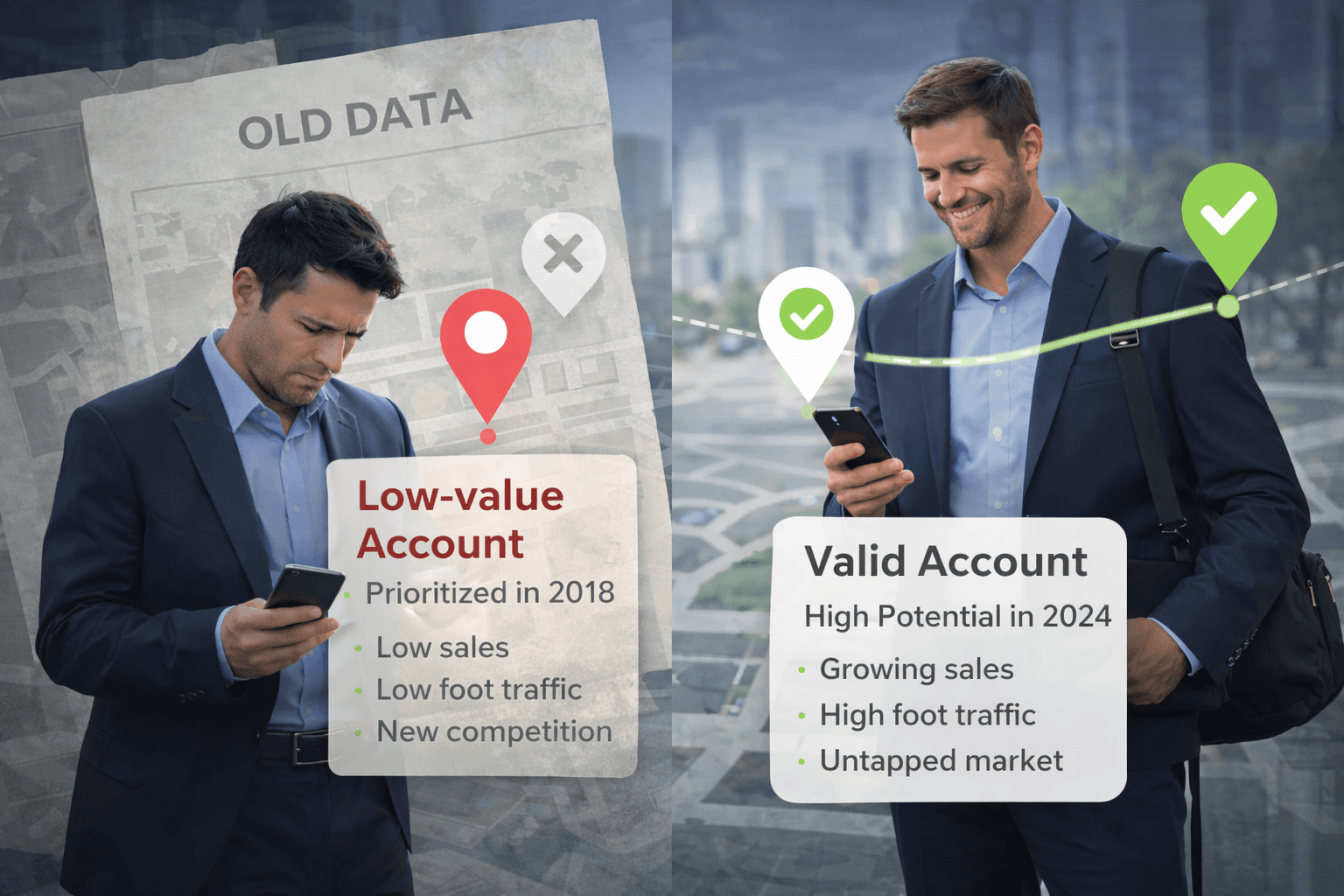
Your reps are working hard. They're logging the hours, hitting the road early, and grinding through their stop lists. The problem isn't effort. The problem is the map they're working from.
Most field sales teams — distributors, CPG operators, vending companies, route-based sales organizations — are executing against territory assumptions that were built years ago and never seriously revisited. The zones made sense when they were drawn. The accounts were prioritized based on whatever data was available at the time. Routes got optimized around what was familiar.
And then the market moved. Population density shifted. New commercial corridors opened. Competitors repositioned. Consumer patterns changed. But the territory plan didn't.
The result is a quiet, invisible form of revenue leakage. Reps are driving routes that no longer reflect the actual distribution of demand. They're visiting accounts with low conversion potential out of habit while skipping zones where the opportunity has grown. Nobody is doing anything wrong, exactly. The system just hasn't been updated.
Location intelligence fixes that. Here's how.
The Real Cost of Habit-Driven Routing
Ask a field sales manager how their reps build their daily routes and you'll often get some version of: 'They know their territory.' Which is true. Your experienced reps have spent years mentally mapping their zones. They know which accounts are worth the stop, which neighbourhoods tend to convert, and which roads to avoid on a Tuesday morning.
That intuition is genuinely valuable. But it has three serious problems.
First, it's frozen in time. Your rep's mental map of the territory reflects the market as it existed when they built it — often 2, 3, or 5 years ago. The market doesn't care about their mental map.
Second, it's not transferable. When that rep leaves, their knowledge walks out the door. Their replacement starts from scratch, navigating blind, making the same mistakes your best rep spent years learning to avoid.
Third, it doesn't scale. You can't build a repeatable growth playbook on individual intuition. If your expansion strategy depends on finding more reps who've already learned their territory the hard way, you don't have a strategy — you have a hope.
"The best reps aren't better because they work harder. They're better because they've built a mental model of where demand lives. Location intelligence gives everyone that model on day one." |
The hidden cost shows up in conversion rates. The typical distributor or CPG operator sees conversion rates that vary wildly across their rep roster — top performers converting 2–3x the rate of the median. A significant portion of that gap isn't skill. It's information.
2–3x Conversion gap between top and median reps | 30% Avg. rep time spent on low-potential stops | 80% Propin pilot-to-revenue conversion rate |
What 'Wrong Account' Actually Means in Field Sales
When we talk about field teams visiting the wrong accounts, we don't mean they're going to accounts that have no potential whatsoever. We mean something more specific: they're allocating their finite time and attention to accounts whose potential doesn't justify the visit — while systematically undervisiting zones and accounts with higher conversion probability.
Wrong accounts typically fall into three categories:
1. Legacy accounts with declining potential
These are the stops that used to justify a weekly visit but don't anymore. Traffic patterns shifted. A new competitor opened nearby. The area's commercial density dropped. Nobody updated the priority list because nobody was looking at the signals.
2. Proximity stops that aren't high-value
Reps are human. They batch nearby accounts even when those accounts have lower conversion probability than others further away. It feels efficient. In terms of drive time, it is. In terms of revenue output, it often isn't.
3. Undiscovered high-potential accounts
This is the most painful category: the accounts your reps drive past every week without knowing they're there. New businesses in a growing commercial corridor. A neighborhood that's seen population growth. A cluster of accounts your competitors are underserving. These aren't invisible — the data exists to find them. They're just invisible to a rep relying on memory.
 |
How Location Data Surfaces What You're Missing
Location intelligence works by layering multiple real-world data signals on top of your territory map to show you where commercial demand actually exists today — not where it existed when you drew your territory lines.
The signals that matter most for field sales include:
Mobile movement data — anonymized foot traffic patterns showing which commercial areas see the most activity, at what times, and from what demographic profiles.
Commercial density — the concentration of businesses, storefronts, and commercial activity in a given zone, updated in near real-time.
Demographic shifts — population changes, income distribution, and household profile data that predict demand trajectories.
Competitor presence — where your competitors are positioned and, critically, where they're not.
Sales performance signals — your own historical conversion data layered against geographic context to reveal patterns you can't see in a spreadsheet.
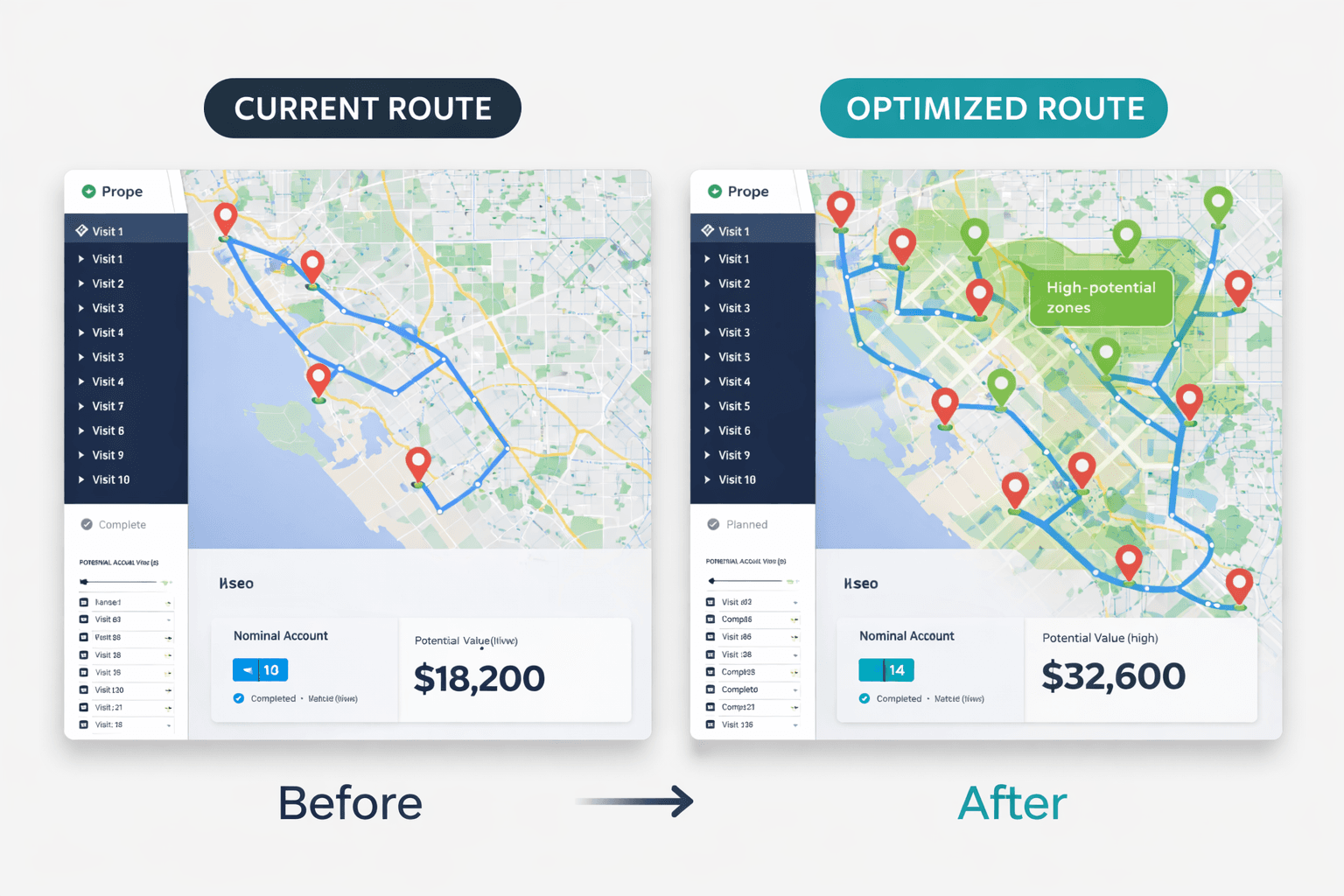
When you stack these signals together on a map, two things happen. First, you see your current territory through a different lens — which zones are actually high-value vs. which feel high-value because your reps know them well. Second, you start to see white space: commercial zones with strong demand signals that your team has been underserving.
"The data doesn't tell your reps where to go. It tells them where the demand is. The rep still owns the relationship. They just start the day better informed." |
Three Signals That Predict Conversion Before a Rep Arrives
Not all location signals are equally useful for field sales prioritization. Based on our pilots with distributors and CPG operators, three signals consistently predict conversion probability before a rep ever walks through the door:
Commercial foot traffic density
High foot traffic in a commercial zone is a reliable leading indicator of account viability. It predicts both direct customer opportunity and the health of the surrounding business environment. Accounts in high-traffic zones tend to convert faster and reorder more frequently.
Recency of commercial activity
A zone that was average two years ago but has seen growing commercial activity in the last six months is a much better bet than a zone that peaked and is now declining. Recency signals let you get ahead of the opportunity curve instead of chasing yesterday's market.
Competitor undercoverage
Zones where your competitors have low presence relative to commercial density are your highest-priority expansion targets. These aren't just good accounts — they're accounts your competitors haven't claimed yet. That window closes. Location data helps you identify it while it's still open.
What This Looked Like for a CPG Distributor in Practice
A regional CPG distributor came to Propin with a familiar problem: flat conversion rates despite adding headcount, and a sales ops manager who was increasingly convinced that the territory design was the issue, not rep performance.
We ran a 90-day pilot in two of their territories. The first thing we did was overlay their rep route data against our location signals. What we found confirmed the hypothesis: reps were concentrating activity in the same zones they'd always worked, while two commercial corridors with growing foot traffic and low competitor presence were almost completely unvisited.
In one corridor alone, our analysis identified 47 accounts with strong conversion signals that had never received a first visit. Not because the reps were neglecting their job — the accounts were outside the informal mental map of the territory.
Over the 90-day pilot, reps using Propin's prioritized account lists converted new accounts at 2.1x the rate of the control group still working their standard routes. The territory design hadn't changed. The market hadn't changed. The information the reps were working with had changed.
The pilot converted to a full contract at the end of the 90 days.
How to Start Without Overhauling Your Stack
One of the most common concerns we hear from sales ops managers is that adopting location intelligence means a major technology project. It doesn't have to.
Propin is designed to sit above your existing CRM and ERP — it doesn't replace them. It ingests your sales performance data and layers location signals on top, giving you a prioritized view of your territory without requiring you to change how your reps log activity or how your ops team tracks performance.
The typical engagement starts with a pilot: a defined territory, a 60–90 day window, and a clear metric we're trying to move. If we can't show measurable lift in that window, the conversation ends there. If we can — and in 80% of cases, we do — the economics of expanding to your full territory are straightforward.
You don't need to solve your entire data infrastructure problem to start getting value from location intelligence. You need a territory, a rep team, and a clear baseline to beat.